

Messaging & Intro to George Lakoff

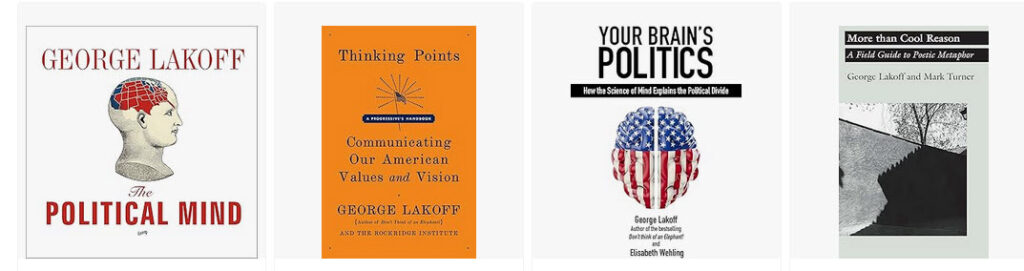
Some ideas from George Lakoff include:
🧩 1. The Core Idea of “Framing”
Lakoff’s central claim is that the way we think is shaped by mental “frames.”
A frame is a structure of concepts that organizes how we perceive and interpret the world.
- A frame defines what counts as relevant, what causes what, who is responsible, and what moral lessons are drawn.
- When we hear or use words, those words activate certain frames in our minds — often unconsciously.
Example:
“Tax relief”
This phrase activates a frame in which taxes are an affliction, the taxpayer is a victim, and the government is a villain — implying that cutting taxes is “helping” or “rescuing.”
By contrast:
“Public investment”
activates a frame in which taxes fund shared goods, cooperation, and future benefit.
So, frames shape political reasoning before facts are even considered.
💭 2. How Frames Work in the Mind
- Lakoff draws from cognitive linguistics — meaning and reasoning arise from embodied experience, not just logic or abstract rules.
- Frames are stored in neural circuits: repeated language and experience make them stronger.
- When a frame is activated, it inhibits competing frames.
→ Hearing one kind of story about an issue (“crime as war”) makes it harder to think in another (“crime as public health”).
That’s why Lakoff warns: “Don’t negate your opponent’s frame.”
If you say “Don’t think of an elephant,” you’ve already activated the “elephant” frame.
🧭 3. “Values” and Moral Systems
Lakoff argues that politics is really a conflict of moral worldviews, each built on different core values — and these are structured by family metaphors.
Two main moral models (especially in U.S. politics):
| Model | Metaphor | Core Values | Typical Associations |
|---|---|---|---|
| Strict Father | The nation as a family with a strong father who enforces discipline | Authority, self-reliance, punishment for wrongdoing, moral order | Conservative worldview |
| Nurturant Parent | The nation as a family where parents care and empower | Empathy, fairness, protection, helping others grow responsibly | Progressive worldview |
Each side sees its values as moral truths.
So, for example, “freedom” means different things depending on the frame:
- For conservatives: freedom from government interference (strict-father autonomy).
- For progressives: freedom to realize one’s potential (nurturant support).
🧠 4. Why “Framing” Matters Politically
Lakoff’s point is that facts alone rarely change minds.
People interpret facts through frames that align with their moral values.
Thus, successful political communication requires:
- Knowing which frames your audience uses,
- Framing your own ideas in terms of shared values, not just data,
- Avoiding the repetition of opponents’ frames (which strengthens them).
📚 5. Key Books
If you want to go deeper, Lakoff’s main works on this are:
- Don’t Think of an Elephant! (2004, updated 2014) — practical, political focus.
- Moral Politics: How Liberals and Conservatives Think (1996, expanded 2016) — theoretical foundation.
- The Political Mind (2008) — about cognitive science, metaphors, and how the brain processes politics.
- Metaphors We Live By (with Mark Johnson, 1980) — not political per se, but introduces the idea that metaphor is conceptual, not just linguistic.

Guide to how this becomes practical ie;
Here’s how to recognize and decode frames when you encounter political language, news coverage, or even everyday conversations.
🧭 1. Look for the Metaphors Behind the Words
Frames are often built from conceptual metaphors — everyday images that structure complex issues.
| Example phrase | Hidden metaphor (frame) | Implication |
|---|---|---|
| “War on drugs” | Crime is war | We must defeat an enemy, not heal addiction. |
| “Moral decay” | Society is a body | Immorality is a disease; needs cleansing or discipline. |
| “Economic engine” | The economy is a machine | Needs to be fueled, tuned, fixed — people are parts. |
| “Tax relief” | Tax is an affliction | Government is a burden, taxpayers are victims. |
When you hear strong metaphorical words — war, fight, drain, fix, cleanse, save — ask yourself:
“What picture of the world is this activating?”
🏛️ 2. Notice Who the Actors Are
Frames often assign roles: hero, victim, villain, rescuer.
- “Hardworking taxpayers” → hero
- “Welfare cheats” → villain
- “Government handouts” → villainous rescuer
- “Small businesses” → virtuous underdogs
Ask:
“Who is being made morally good or bad in this story?”
“Whose agency is emphasized or erased?”
If government is always the villain and the market the hero, that’s a Strict Father moral frame.
If government is the caring parent that ensures fairness, that’s a Nurturant Parent frame.
💰 3. Check for Moral Language Disguised as Facts
Lakoff says there’s no such thing as purely neutral language in politics — words carry values.
Example:
- “Entitlement programs” implies undeserved claims.
- “Social insurance” implies shared protection.
Both describe the same thing (Social Security, Medicare) but invoke different moral logic.
So, when reading headlines, notice adjectives:
- “burdensome,” “reckless,” “responsible,” “job-killing,” “family-friendly” — each reflects a value, not just a fact.
🧩 4. Identify Implicit Goals and Causation
Frames determine what counts as the cause of a problem and what the “solution” looks like.
Example:
- “Crime is caused by moral weakness” → solution = punishment.
- “Crime is caused by poverty and neglect” → solution = social support.
Different frames produce completely different policy conclusions even with the same data.
Ask:
“What is being assumed about why this problem exists?”
“What kind of solution sounds ‘natural’ in this frame?”
🧠 5. Be Aware of Negations and Traps
Lakoff warns: “Don’t use your opponent’s language to rebut them.”
When someone says “Don’t think of an elephant,” your brain activates the “elephant” frame — even if you’re denying it.
So instead of saying:
“We’re not against freedom.”
You would reframe:
“We stand for the freedom to live with dignity.”
That is, replace the frame — don’t argue within it.
📰 6. Watch for Journalistic Neutrality Framing
Even “objective” reporting often adopts dominant frames unconsciously:
- “Law and order” frame: emphasizes crime as moral threat, legitimizes crackdowns.
- “Middle class tax relief” frame: presumes taxes are harm, not contribution.
- “Border crisis” frame: activates invasion metaphor, fear, defense.
Journalists often inherit these metaphors from official sources.
Lakoff calls this the “framing trap of balance” — appearing neutral but reinforcing one moral system’s assumptions.
🧩 7. Practice Reframing
Once you spot a frame, try rewriting it with a different moral logic.
Example:
| Original | Reframed |
|---|---|
| “Welfare dependency” | “Economic security” |
| “Climate change regulation” | “Clean energy freedom” |
| “Tax burden” | “Shared investment in our future” |
| “Border protection” | “Fair and humane immigration system” |
You’re not changing facts — you’re changing the story those facts live in.
🪶 8. How to Train Your Ear
- Highlight key nouns and verbs in an article.
Ask what metaphors they imply. - Look for repetition. Frames are strengthened by repeated phrases.
- Compare two sides’ language on the same issue — note how each defines morality, responsibility, and identity.
- Write both frames side by side. This makes their moral contrast visible.
Would you like me to make a practical worksheet (in table format) you could print — with columns like “Phrase,” “Frame it invokes,” “Opposing frame,” “Your reframe version”?
It’s an easy way to practice spotting and reshaping frames in real-world examples (news headlines, campaign slogans, etc.).